top of page

SiteCortex

Everyone has a cortex. Your projects deserve SiteCortex.


SiteCortex

Construction Management Platform

Everyone has a cortex.Your projects deserve SiteCortex.

Real-time project management and cost control platform for large-scale construction projects. From field data to EVM reports, from BOQ to PO, from subcontractor payments to fixed-asset tracking — a single source of truth on a single server.

🌍 23+ projects · 4 countries · 3 continents💰 ~$8.2 Billion USD combined contract value📊 2,700+ materials · 813 quotes · 89 suppliers🌐 buldun.app/dev

Core Principle 1

Database-Driven Architecture

Core Principle 2

Auto-Compute by Design

Core Principle 3

Mobile-First Field Operations

Core Principle 4

Audit-First — Every Datum Traceable

1The Problem — Construction Sites Still Run on Excel

Large-scale construction projects face the same silent struggle worldwide: data arrives late, deviations are noticed too late, budget ceilings are remembered too late. The problem is not the people — it is the system.

30%+

Budget Overrun

The "normal" overrun the industry has come to accept on large projects. By the time it's visible, it's irreversible.

45%

Missing / Late Data

Nearly half of the field data reaching reports is incomplete or delayed. Decisions are made in the dark.

3–6 Months

Time to Notice Deviations

Critical cost and schedule deviations surface only after periodic reports. Far too late to act on.

Even the best engineer cannot track hundreds of cost items, dozens of machines, hundreds of personnel, and a constantly shifting scope — simultaneously, in real time, error-free. Running a project on Excel is like crossing the ocean without a compass.

2The Solution — SiteCortex's 4-Stage Workflow

A purpose-built digital cortex for projects: a single source of truth that works in four stages. The field only enters data — the system produces everything else automatically.

Collect

Captures daily field data: labor-hours, machine hours, fuel, materials, progress — desktop + mobile, offline-first.

Correlate

Automatically matches data to BOQ, analysis recipes, procurement records, and the schedule. Work Allocation binds crews to TaskBOQ.

Analyze

Generates EV, SPI/CPI, EAC, unit-cost trends, variance analysis, and forecasts automatically — dashboards update the moment data lands.

Alert

Raises early warnings the instant deviations emerge — budget breaches, tolerance overruns, missing data, anomalies — and recommends action.

The principle: Bring the data. Get the decision. SiteCortex handles the rest.

3Field Touch — Minimum Effort, Maximum Data

The site engineer completes the daily entry in two minutes. The rest is automatic: cost allocation, crew timesheets, machine hours, subcontractor progress payments.

Work Allocation

  • Personnel + machinery → assigned to a crew

  • Crew → bound to an activity / TaskBOQ leaf

  • Date-range membership (mid-month changes supported)

  • Automatic cost allocation — crew-hours × analysis unit cost

Timesheet (31-Day Scorecard Grid)

  • One row, whole month — Excel speed with ERP audit trail

  • Personnel: hours + leave / overtime status

  • Machinery: running hours + fuel + downtime

  • Subcontractor: cumulative IPC entry

Data flow: ① Timesheet (daily, ~ 2 min) → ② Work Allocation matching → ③ Automatic cost distribution → ④ Activity-level actual cost → ⑤ Variance + EV metrics

4Cost & Planning — Earned Value Management on a Single Spine

Scope baseline → schedule baseline → cost baseline → performance measurement baseline, integrated on a single EVM spine. PV, EV, AC, SPI, CPI, EAC — all live, all at TaskBOQ leaf level.

Metric

Source

Definition

PV (Planned Value)

SiteCortex Schedule (CPM + Linear)

TaskBOQ planned quantity × analysis unit cost, cumulative

EV (Earned Value)

WorkAllocation

TaskBOQ leaf actual quantity × analysis unit cost

AC (Actual Cost)

Timesheet + Materials + Subcontractors + Logistics

Real spending flowing to TaskBOQ leaf

SPI / CPI

Derived

Schedule and cost efficiency — 1.0 = on baseline, > 1.0 = ahead/under

TaskBOQ Quantity Tolerance Guard: cumulative actual quantity ≤ planned × 1.05 — anything beyond a 5% overrun is treated as a true scope expansion and handled via baseline revision (ICC), never by relaxing the guard. EV inflation (gaming CPI by over-reporting quantity) is structurally blocked.

5BOQ, Analysis Library & Procurement

End-to-end digital procurement — from BOQ tree to unit-cost derivation, from quote comparison to PO release. Pre-loaded analysis libraries and fuzzy Excel import put a new deployment in production within the first week.

BOQ Management

  • TreeGrid: Bill → Section → Item, unlimited depth

  • Recursive CTE view (vw_BoqCostAnalysisTree) — composite recipes flattened

  • Unit-price cascade: PriceList → Variant → 0 fallback

Pre-Loaded Analysis Libraries

  • Public-works standards (national institutes) — seed-as-go

  • Composite → Labor / Machinery / Material / Transport

  • Formula engine: COALESCE, IF, child_value, sum_children

Material Hierarchy

  • Category → Material → Variant (TreeListView)

  • 2,700+ materials · 3,000+ variants (reference dataset)

  • Mixed-level tree-popup selection

Quotation Evaluation (QEF)

  • 338 firms · 89 quotes · 813 line items processed (reference)

  • Prices normalized to base currency (EUR/USD/local)

  • Material vs Service distinction — alternative product proposals

Streamlined Procurement Flow (R01)

  • MR → PR → RFQ → QEF → PO chain

  • Request flow: 2 digital approvals (Dept Chief + Warehouse) → direct RFQ queue

  • QEF approval = PO issuance (simultaneous, agile-ERP model)

  • 3-way match: PO ↔ GR ↔ Expense, canonical FK

Excel Import

  • Fuzzy header matching + alias

  • Parent auto-create, bulk create

  • Duplicate detection

6Subcontractor Contracts & Interim Payment Certificates (IPC)

Subcontractor contracts, unit prices, and periodic interim payment certificates on a single digital trail. Every IPC line is bound to a contract unit price and to TaskBOQ — planned-vs-actual dashboards feed off this link.

Contract Lifecycle

  • Draft → Active → Closed / Cancelled — system-guarded

  • Unit-price lines + "Tender Counterpart" (generic subcontractor of plan)

  • Advance + Retention automation — gross − advance − retention = net

  • R01: "Activate" owned by Technical Manager, based on signed contract evidence

IPC Pivot Grid + Agile AC

  • Dynamic IPC columns (IPC1, IPC2, …) — cumulative quantity entry

  • System computes gross → advance deduction → retention accrual → net

  • Posted IPC → CCP SubcontractorPayment AC channel

  • 3-way match: PO/GR/Expense + contract-line linkage

7Administrative Affairs — Three-Warehouse Model + Fixed Assets + Logistics

The system's warehouse architecture rests on three parallel warehouses — clarifying operational scope and approval routing, preventing cross-responsibility drift.

IT Warehouse

→ IT Chief approval

Computers, network gear, hardware — stock release approved by the IT Chief.

Admin Warehouse

→ Admin Chief approval

Office supplies, stationery, service consumables — stock release approved by the Administrative Affairs Chief.

Site Warehouse

→ Site Warehouse Chief approval

Site consumables, spares, small tools — stock release approved by the Site Warehouse Chief.

Stock-release approval model: Each catalog item belongs to one warehouse (by category / stock location). The warehouse handles physical stock control, and the chief of the relevant warehouse approves the release. Insufficient stock automatically generates a PR draft and routes it to the procurement flow. No cross-approval, no diffused ownership.

Fixed-Asset Management

  • Barcode/QR labelling + unique asset code

  • Assignment, transfer, count, damage, disposal — full lifecycle

  • Post-GRN IsAssetTrackable=1 auto-queue

Transport + Accommodation + Catering

  • Vehicle requests, dispatch/return, fuel, km, damage

  • Room allocation, check-in/check-out, damage reports

  • Catering quality and water-analysis tracking

8Analysis Creator — Run-Traceable Quantity Generation

A pluggable, generic quantity-generation engine. First citizen: the Tunnel NATM Quantity Generator (twin-tube highway NATM tunnel). Road earthwork, bridge piling, drainage culvert generators plug into the same backbone (V2+).

5-Step Wizard

  • Tunnel identity → geometry → NATM class distribution

  • Productivity profile selection / override

  • Preview + commit (BOQ + Cost Analysis link)

P10 / P50 / P90 Uncertainty Band

  • CapacityLow / MostLikely / High productivity profiles

  • QuantityLow/Most/High → HoursLow/Most/High derivation

  • Seeded from public-works composites

Run Traceability

  • InputJson + AssumptionJson immutable snapshot

  • FormulaVersion stamp at preview

  • Every BOQ item stamped with its run ID

LLM Assistant (Side Panel)

  • Bounded tool-using assistant (Read / Draft categories)

  • Composite search, mapping proposal, override draft

  • Audit-first — every tool call append-only

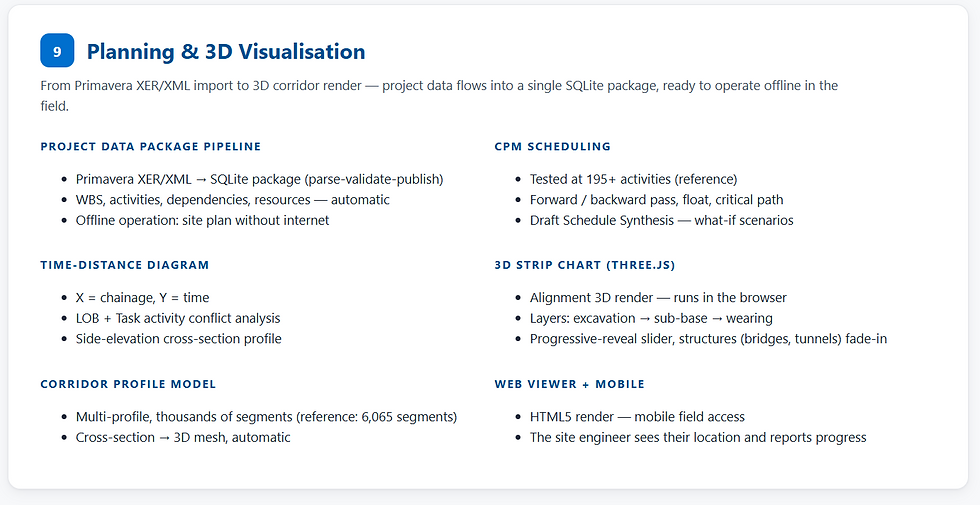
9Planning & 3D Visualisation

From Primavera XER/XML import to 3D corridor render — project data flows into a single SQLite package, ready to operate offline in the field.

Project Data Package Pipeline

  • Primavera XER/XML → SQLite package (parse-validate-publish)

  • WBS, activities, dependencies, resources — automatic

  • Offline operation: site plan without internet

CPM Scheduling

  • Tested at 195+ activities (reference)

  • Forward / backward pass, float, critical path

  • Draft Schedule Synthesis — what-if scenarios

Time-Distance Diagram

  • X = chainage, Y = time

  • LOB + Task activity conflict analysis

  • Side-elevation cross-section profile

3D Strip Chart (Three.js)

  • Alignment 3D render — runs in the browser

  • Layers: excavation → sub-base → wearing

  • Progressive-reveal slider, structures (bridges, tunnels) fade-in

Corridor Profile Model

  • Multi-profile, thousands of segments (reference: 6,065 segments)

  • Cross-section → 3D mesh, automatic

Web Viewer + Mobile

  • HTML5 render — mobile field access

  • The site engineer sees their location and reports progress

10Platform Technology — No-Code Config + Cross-Platform

New grid, new screen, new report — no code, just DB metadata. 19 rules keep the system consistent; the platform expands while stability holds.

No-Code Config

  • New grid = a single DB metadata row

  • 19 rules of the Runtime Metadata Contract

Formula Engine

  • COALESCE, IF, child_value

  • detail_value, sum_children

TreeListView

  • BOQ ↔ Analysis ↔ Material, unlimited depth

  • Tree popup, mixed-level lookup

.NET 10 + Avalonia

  • Cross-platform desktop: Windows, Linux, macOS

  • Native performance, modern UI

3D Viewer

  • Three.js strip chart

  • Time-distance diagram, web + mobile

Excel Import

  • Fuzzy matching, alias, parent auto-create

  • Bulk create, duplicate detection

Context Security

  • Workspace-scoped isolation

  • Per-row edit permission, role-aware data

Work Allocation

  • Crew → Activity automatic cost allocation

  • Date-range membership

Auto-Update

  • FileTable delta update — one-click publish

  • Automatic version push to the field

11Document Coding Standard (DCS)

Every procedure, form, and transactional record carries a common, searchable, traceable code — across projects, across years.

Code Type

Format

Example

Template / Versioned

COMP-<DISC>-<SUBJ>-<TYPE>-<NNN>

COMP-PCS-MRQ-FRM-001 (Material Request Form)

Transactional / Record

COMP-<TXN>-<YYYY>-<NNNN>

COMP-MR-2026-00050 (each filled MR is a separate record)

Interim Payment (IPC)

year-resetting sequence

COMP-IPC-2026-0001

Minutes of Meeting (MOM)

year-resetting sequence

COMP-MOM-2026-0001

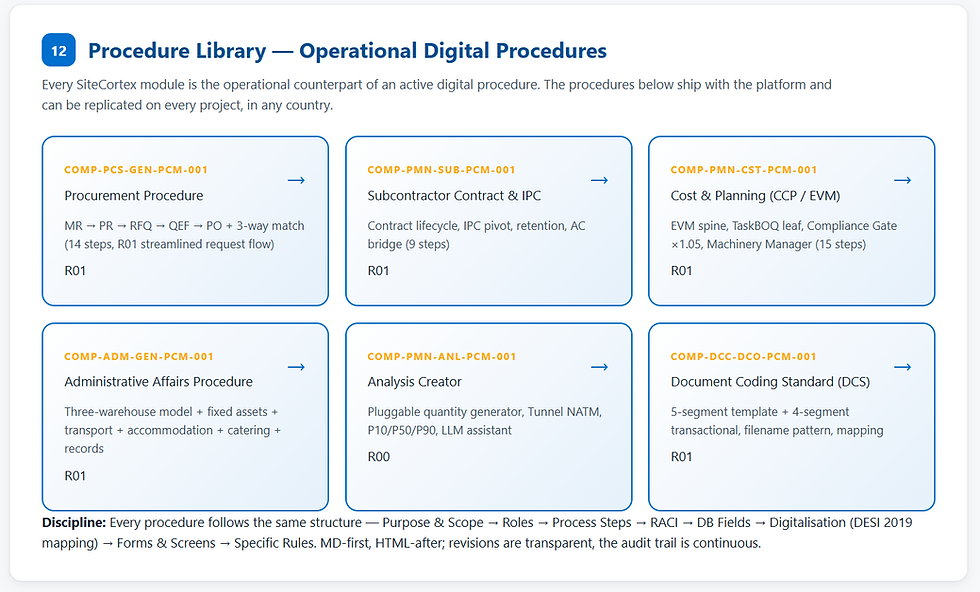
12Procedure Library — Operational Digital Procedures

Every SiteCortex module is the operational counterpart of an active digital procedure. The procedures below ship with the platform and can be replicated on every project, in any country.

Discipline: Every procedure follows the same structure — Purpose & Scope → Roles → Process Steps → RACI → DB Fields → Digitalisation (DESI 2019 mapping) → Forms & Screens → Specific Rules. MD-first, HTML-after; revisions are transparent, the audit trail is continuous.

13Reference Projects — Tested on Site, Proven on Site

SiteCortex is in active use today across 23+ large-scale infrastructure projects — highways, railways, tunnels, ports — with ~$8.2 Billion USD in combined contract value across three continents.

🇰🇿 Kazakhstan

16 Projects · $2 Billion+

Transit-corridor highway construction — long-term enterprise deployment, combined contract value above USD 2 Billion.

🇴🇲 Oman

3 Projects · $200 Million

Jebel Akhdar mountain road and fishing harbours — field-tested in mountain conditions, USD 200 Million combined value.

🇺🇬 Uganda

SGR · $3.5 Billion

Standard Gauge Railway construction — ongoing flagship project, USD 3.5 Billion contract value.

🇷🇴 Romania

Tunnel Highway · $2.5 Billion

NATM tunnel + full integration, USD 2.5 Billion contract — 2,700+ materials, 813 quotes, 89 suppliers, 3D strip chart.

Combined portfolio: ~$8.2 Billion USD total contract value · 23+ projects · 4 countries · 3 continents.


Operational volume: 2,700+ materials · 3,000+ variants · 195+ activities · 6,065 corridor segments · 813 quote line items · 89 suppliers · 14-step procurement flow · 15-step EVM spine.

The Thinking Brain of Your Project

SiteCortex collects field data; correlates it with BOQ, analyses, schedule and procurement; produces EVM metrics live; and alerts the moment a deviation appears. Every module is backed by a digital procedure — every action carries a who/when/why audit trail. On your next project, SiteCortex turns field data into decisions from the very first week.

Everyone has a cortex. Your project deserves SiteCortex.

SiteCortex

Construction Management Platform · Real-Time Project & Cost Control


Cost & Planning Procedure↑ Back to pitch

Procurement Procedure↑ Back to pitch

Subcontractor Contract & IPC Procedure↑ Back to pitch

Administrative Affairs Procedure↑ Back to pitch

Analysis Creator Procedure↑ Back to pitch

Document Coding Standard (DCS)↑ Back to pitch


Son Yazılar

Hepsini Gör
Hakediş'in Mantığı Genel Tanımlar

Santiyeci.Com - Genel Bilgiler - Hakediş 1.Bölüm Hakediş'in Mantığı Genel tanımlar. Aylık üretim nasıl hakediş haline getirilir. https://www.youtube.com/watch?v=j-cVqcsJuNA


Şantiye Notları - Kitap

Veysel YILMAZ-Şantiye Notları İkinci Adam Yayınları https://www.youtube.com/watch?v=xiIv5sE5aP8&list=RDxiIv5sE5aP8&start_radio=1


Yorumlar


bottom of page